
I’ve had a longstanding fascination with ancient religious sites in Britain, and I’ve decided that this year I’m going to be working on new images inspired by them.
In November I showed my new etching and aquatint The Migrants at Adam’s Gallery in Reigate in an exhibition paying homage to Paul Drury. I bought the catalogue raisonné of his prints and was attracted by the ancient megaliths which he had moved to alternative locations.
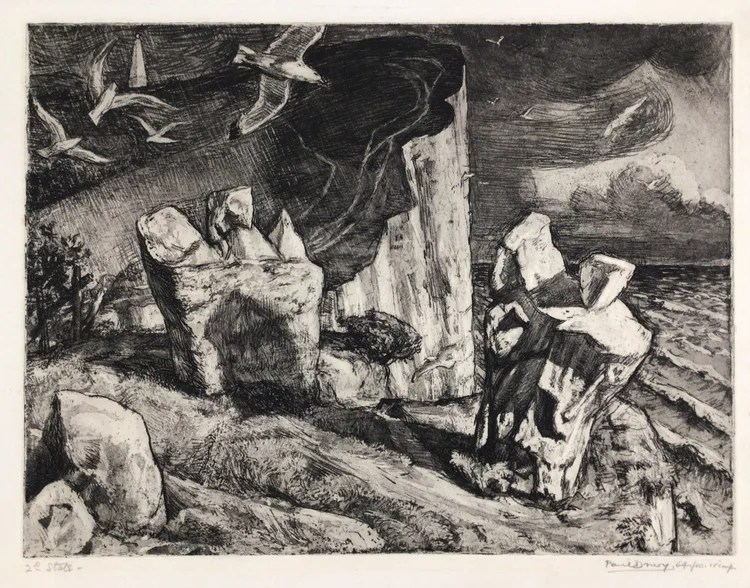
Paul Drury – Ancient Stones in a Landscape IV – Etching and aquatint 1964
Having just visited the Henry Moore Foundation in Hertfordshire, I was already thinking about his monolithic sculptures placed around the estate, and I decided to move several of Drury’s stones into the landscape I was creating, based on a photo of my brother and his wife at the estate, the last time I saw them before they moved up to Cumbria.

The Migrants – Etching and aquatint – 2025 – Kit Boyd
I’ve just been to Avebury this last weekend with another stone circle and Julian Cope fan, my friend John who now lives in Gloucestershire. Here’s the left hand stone from Drury’s etching at Avebury on a completely sodden Sunday on February 1st

I’m pretty sure Drury moved it to the white cliffs at Seaford which I visited in summer last year when delivering some work for an exhibition. I walked over the white cliffs towards the Seven Sisters, with a kestrel as my companion.


You might know what’s coming next…yes this really reminded me of another artist I’m passionate about, Paul Nash. He also liked moving megaliths around and creating landscapes from his encounters, and he must have been a huge influence on Drury’s standing stones too.


Paul Nash’s strange atmospheres were successfully replicated by Drury I feel. I’m hoping to be able to make work that gets even a tiny bit close to their strangeness and atmosphere.
Here’s a two plate etching with additional ink and acrylic I made of Mayburgh Henge a few years back with Ian Rawlinson at Morley College on a short course experimenting with photoetching. I recently went back to these and recoloured them. It’s an edition of 11, each one differently coloured.


Mayburgh Henge is in Cumbria just outside Penrith and close to the M6, and has an undeniable oddness despite the traffic noise. My parents live close by and never go there, but I always make a point of visiting (a good walk down the River Eamont from Brougham Castle). I’ve been there in the snow, and seen the animal tracks across the circle, and during a thunderstorm which filled the whole place with energy.
Last year the Ithell Colquhoun exhibition came to Tate Britain. I was particularly drawn to the Dance of the Nine Opals with it’s magical magnetic energy.

For her there was a lot of symbolism and magic in the stones, and I feel she was able to create an attractive oil painting that was personally meaningful and mysterious. There is something about the brightness of colour too that feels appropriate in portraying the stones (in this case the Merry Maidens in Cornwall) because they need a heightened reality.
If you look back at a post I made in 2013 about Avebury following a trip I made with my friends Martin and Kate, you’ll see that I created multi-coloured images from the original photos of the circle and the stones that felt entirely appropriate. They are of course strongly influenced by Julian Cope’s fluorescent colour choices for his gazetteers The Modern Antiquarian and The Megalithic European, and his albums Interpreter and Jehovakill. Again the wild and clashing colours seem appropriate in expressing a connection to the earth and the emotional response to these ancient places.
When we visited Avebury on Sunday the rain was relentless. The wonderful thing about it (obviously not the soaking we got) was the colours the water brought out in the stones. It felt truly inspiring, so I’ve started to do the same again with this batch of photos as a starting point for new work.


Interestingly enough, and back to the start of this post, I only just realised that the large central stone here is another one that Drury moved around back in the 1960s. This is Ancient Stones I which was also shown at Adam’s Gallery in Reigate last year.

I’ll be writing more and posting more this year about places that I’ve been, and other artists exploring this rich and mysterious imagery inspired by the weird and wonderful ancient UK sites, including Orkney where I went in 2018, Castlerigg, Mitchell’s Fold near my old home in Wales, the Rollright Stones and Long Meg and her Five Daughters.

Leave a Reply